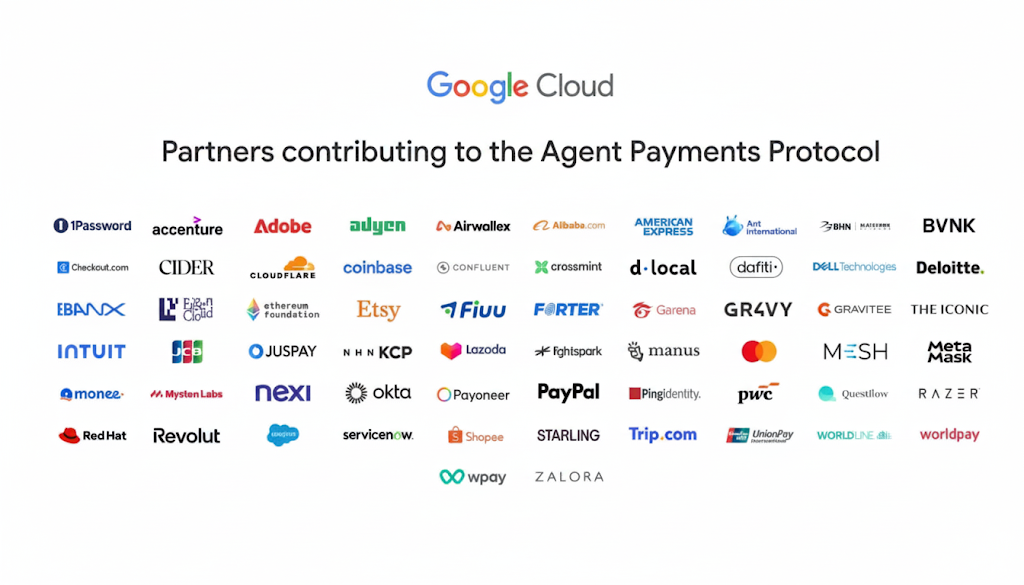
Google is working with more than 60 partners to shape the future of AI payments. Its cloud division has introduced the Agent Payments Protocol (AP2), a shared framework designed to make agent-led transactions safer and easier across platforms.
AP2 extends earlier efforts such as the Agent2Agent (A2A) and Model Context Protocol (MCP). Working alongside existing payment rules and standards, it provides a payment-neutral system that lets users, merchants, and providers transact securely, regardless of the method—credit cards, bank transfers, or digital currencies.
More than 60 organisations are taking part in shaping AP2, including Southeast Asia players like Airwallex, Fiuu, Garena, Lazada, Razer, Shopee, and ZALORA, as well as global companies such as Adyen, American Express, Coinbase, JCB, Mastercard, MetaMask, PayPal, Trip.com, UnionPay International, and Worldpay.
Why AP2 matters
The rise of AI agents changes a basic assumption of payment systems—that a human is always the one pressing “buy.” When an agent can make purchases on behalf of a user, new questions arise about how to prove authority, confirm intent, and resolve disputes when something goes wrong. AP2 was created to address these challenges by providing a secure foundation for authorisation, authenticity, and accountability in transactions.
“AP2 is an open, shared protocol that provides a common language for secure, compliant transactions between agents and merchants,” said Rao Surapaneni, Vice President and General Manager of Business Applications Platform at Google Cloud. “It also supports different payment types – from credit and debit cards to stablecoins and real-time bank transfers.
This helps ensure a consistent, secure, and scalable experience for users and merchants, while also providing financial institutions with the clarity they need to effectively manage risk.”
How it works
At the heart of the protocol are Mandates—digitally signed contracts that record a user’s instructions. These contracts, backed by verifiable credentials, create a reliable trail of evidence for each step of a transaction. For example, when someone asks an agent to find a pair of running shoes, the request is logged as an Intent Mandate. Once the user approves the final cart, a Cart Mandate is created, locking in the items and the price. If the task is delegated in advance, such as buying concert tickets when they go on sale, a detailed Intent Mandate specifies the rules. The agent then generates a Cart Mandate when the conditions are met, all without the user being present.
This sequence of events—intent, cart, and payment—provides the proof needed to establish authorisation and authenticity, while leaving a clear record for accountability.
Partners say AP2 will be key to creating confidence in agent-led transactions. Jacob Dai, Co-Founder and CTO of Airwallex, called it “a critical step forward in building a secure, interoperable ecosystem for agentic AI payments.” Eng Sheng Guan, CEO of Fiuu, said the shift toward agent-driven commerce requires open standards like AP2 and A2A to ensure trust and interoperability. Mastercard’s Chief Digital Officer Pablo Fourez added that the company sees the collaboration as part of its broader work on verifiable credentials and standards that strengthen safety across the payments industry.
Unlocking new commerce
The design of AP2 is flexible enough to support both familiar transactions and entirely new types of commerce. A shopper could instruct their agent to monitor the availability of a winter jacket in a specific colour and automatically purchase it once it appears, avoiding a missed sale. In another case, an intent shared with a merchant might trigger a customised offer that bundles several products at a discount. Agents can also work together to complete multi-step tasks such as booking flights and hotels within a set budget, ensuring both transactions meet the user’s conditions and are confirmed simultaneously.
AP2 is not limited to standard payment methods. It was designed as a universal protocol that also supports cryptocurrencies. With partners like Coinbase, Ethereum Foundation, and MetaMask, Google has launched the A2A x402 extension, which enables agent-based crypto payments. Marco De Rossi, AI Lead at MetaMask, said the extension would give developers maximum interoperability while allowing users to keep control of their funds through self-custody.
What’s next
Mark Micallef, Managing Director for Southeast Asia at Google Cloud, pointed to the region’s growing e-commerce market as an example of the scale of opportunity. In 2024, gross merchandise value across sectors such as e-commerce, online travel, and food delivery reached US$263 billion. Digital payments in the region are projected to surpass US$2.1 trillion by 2030, making reliable and secure agent-led transactions all the more important.
Support for AP2 is expected to expand through Google Cloud’s AI Agent Marketplace, where companies are beginning to test agent-based payment experiences. This could extend to B2B uses, such as automated procurement or the automatic adjustment of software licences in response to real-time demand. For Google and its partners, the call now is for wider collaboration, with AP2 positioned as the starting point for building trust in a new era of AI-driven commerce.
See also: News sites lose traffic as Google AI Overviews replace search

Want to learn more about AI and big data from industry leaders? Check out AI & Big Data Expo taking place in Amsterdam, California, and London. The comprehensive event is part of TechEx and is co-located with other leading technology events, click here for more information.
AI News is powered by TechForge Media. Explore other upcoming enterprise technology events and webinars here.