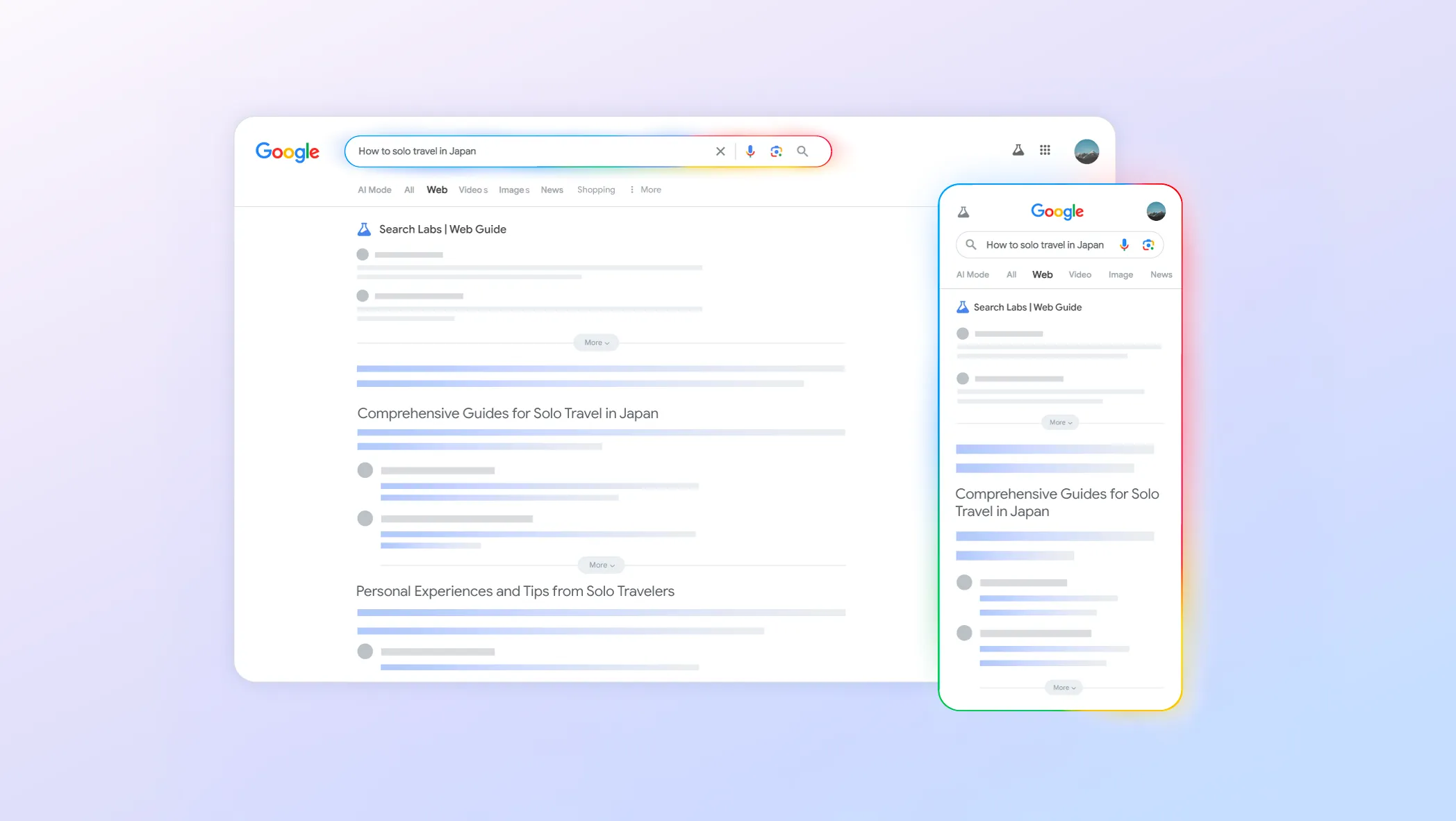
For over two decades, Google has served search results in essentially the same format: a ranked list of blue links that users scroll through to find relevant information. Now, Google’s AI search is challenging that fundamental approach with Web Guide, an experimental feature that doesn’t just find information – it thinks about how to organise it.
The new development could reshape how millions of users discover content online, though whether that change proves beneficial or problematic remains to be seen. Rather than presenting the familiar list of websites ranked by algorithms, Web Guide uses AI to curate, categorise, and contextualise search results in ways that mirror how humans approach complex topics.
What is a Web Guide?
Web Guide represents Google’s latest attempt to move beyond the traditional “10 blue links” approach that has defined search results for decades. Instead of presenting a simple list of websites, this new feature uses AI to group and categorise search results into thematically organised sections, each focusing on different aspects of a user’s query.
According to Austin Wu, Group Product Manager for Search at Google, Web Guide “uses AI to intelligently organise the search results page, making it easier to find information and web pages.”
Technical infrastructure and AI implementation
The backbone of Web Guide relies on a custom version of Gemini, Google’s large language model, modified to understand search queries and web content. The specialised AI system can “better understand both a search query and content on the web, creating more powerful search capabilities that better surface web pages you may not have previously discovered.”
Google search AI powering Web Guide employs a “query fan-out technique,” similar to the technology powering AI Mode. The approach involves “concurrently issuing multiple related searches to identify the most relevant results,” allowing the system to cast a wider net and discover content that might be missed through traditional search methods.
User experience and practical applications
The feature handles open-ended and complex multi-sentence queries. Google suggests trying it for searches like “How to solo travel in Japan?” or detailed requests like “My family is spread in multiple time zones. What are the best tools for staying connected and maintaining close relationships despite the distance?”
For the Japan travel example, Web Guide might organise results into categories like “Comprehensive Guides for Solo Travel in Japan,” “Personal Experiences and Tips from Solo Travellers,” and “Safety and Destination Recommendations.” Each section contains a curated selection of relevant links, with options to reveal additional results in each category.
Availability and rollout strategy
Currently, Web Guide operates as an opt-in feature in Google’s Search Labs program, accessible to users who specifically activate experimental features. Initially, users can access it “from the Web tab on Search, where you can easily switch back to standard Web tab results any time.”
Google plans a gradual expansion strategy. The company stated it will “start to show AI-organised results in other parts of Search, including the ‘All’ results tab, as we learn where they can be most useful in helping people discover the web.” The cautious approach reflects Google’s need to test and refine the feature based on user feedback before broader implementation.
Distinguishing Web Guide from AI mode
While both features use Google’s Gemini AI and similar underlying technologies, they serve different purposes in the search ecosystem. Web Guide “focuses on how results are presented, while AI Mode changes how answers are generated and delivered.”
AI Mode provides conversational, AI-generated responses that synthesise information in sources into answers. In contrast, Web Guide maintains the fundamental structure of traditional search results while applying organisation to help users navigate existing web content.
Industry context and strategic implications
Web Guide arrives amid intensifying competition in AI-powered search, with competitors like Microsoft’s Bing and emerging AI search platforms challenging Google’s dominance. The feature represents part of Google’s broader strategy to maintain its search leadership and adapt to user expectations shaped by conversational AI tools.
What are the potential impacts on content discovery and SEO?
For content creators and digital marketers, Web Guide introduces new considerations for search engine optimisation. The AI-driven categorisation could affect how content gets discovered, potentially rewarding websites that address specific aspects of AI-driven search rather than those optimising purely for keyword matching.
The feature’s ability to surface pages not previously shown could benefit high-quality content that traditionally struggled to rank prominently in conventional search results. However, it also raises questions about how Google search AI will influence traffic distribution in websites and whether the categorisation system might favour certain types of content over others.
While Google positions Web Guide as an improvement in information discovery, the feature raises questions about algorithmic control over information access. The AI’s role in determining which content appears in specific categories could influence user behaviour and potentially limit exposure to diverse perspectives on complex topics.
As an experimental feature, Web Guide’s viability depends on user adoption and feedback. Google’s history with Search Labs experiments shows that not all features graduate to mainstream implementation, regardless of their technical sophistication.
The marketing tech reality check
Web Guide arrives at time when digital marketers and content creators have spent years chasing Google’s ranking algorithms. While the feature promises better content discovery, it also introduces new uncertainties about traffic distribution and visibility strategies that have worked for decades.
The shift toward AI-curated results raises questions about algorithmic transparency. Unlike traditional search rankings, where SEO professionals could at least attempt to reverse-engineer ranking factors, Web Guide’s categorisation logic remains opaque.
The black-box approach could make it significantly harder for marketers to predict and optimise for content placement. Moreover, Google’s history with Search Labs experiments offers a sobering perspective. Features like Circle to Search and AI-powered recipe organisation have seen mixed adoption, and many experimental tools never graduate to full deployment.
For businesses banking on Web Guide’s permanence, the uncertainty represents a strategic risk. The feature also highlights a broader tension in the search ecosystem: as Google search AI becomes more convinced it can interpret user intent, it becomes more powerful as a gatekeeper determining which content surfaces prominently.
The evolution might benefit high-quality publishers but may disadvantage smaller sites lacking the resources to optimise for AI-driven categorisation systems. Whether Web Guide ultimately enhances or complicates the digital marketing landscape will depend on user adoption, how transparently Google communicates its categorisation criteria, and whether the system proves resistant to manipulation – a challenge that has plagued every previous iteration of search technology.